
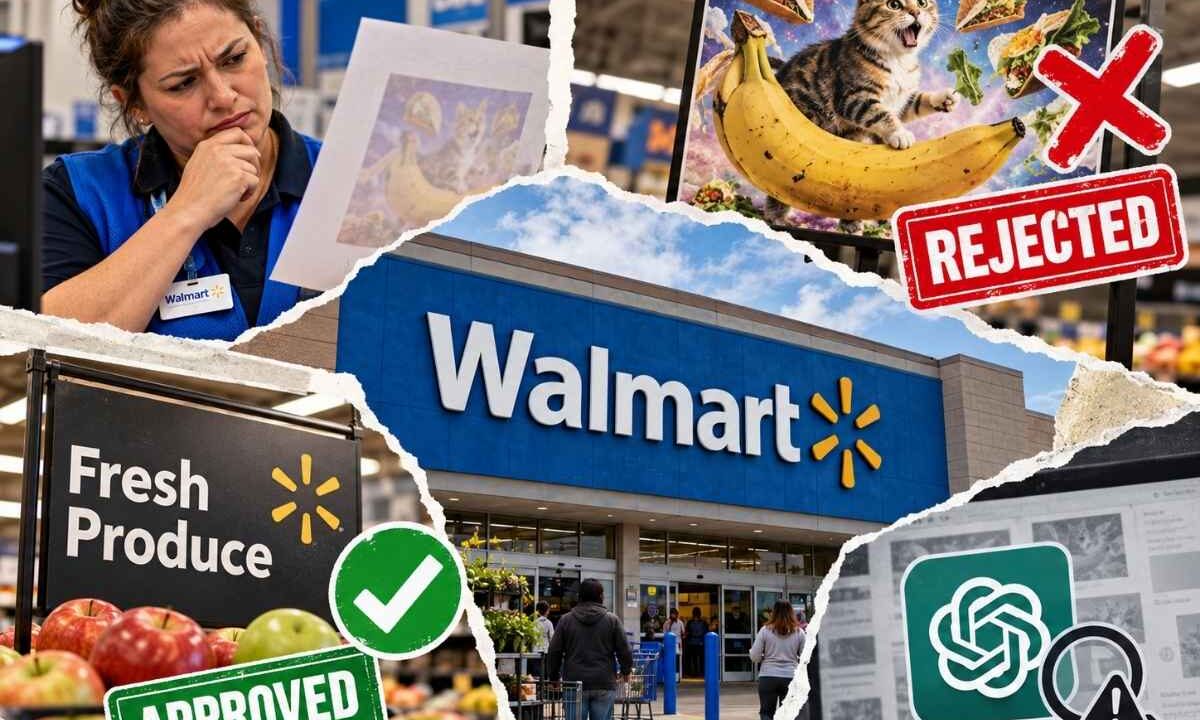
Generative AI can produce a promotional poster in seconds. Walmart would prefer that its stores resist the temptation. Updated signage guidance now explicitly tells employees not to use AI tools to create signs displayed in stores.
Walmart puts it plainly: “Stores should not display signage created by AI tools.” Apparently, technology capable of generating an advertising campaign has met its corporate match: the approved signage catalog.
Walmart has not issued a company-wide ban on generative AI. Instead, its rule targets something much narrower. Store employees should not improvise branded signs with an image generator when an approved corporate system already exists for that job.
In this article
Walmart Closed a New Route Around an Old Rule

Custom print jobs for Walmart signage were already restricted before AI-generated posters entered the conversation. Official signs are generally supposed to be ordered through Walmart’s corporate catalog.
Store photo labs can be used when there is a “critical business need,” and no approved option is available. Adding AI tools to the policy effectively closes another route around those controls.
Generative tools can make ignoring a corporate design system unusually easy. A manager who needs a poster no longer needs Photoshop skills, a designer, or much time. ChatGPT, Claude, Gemini, and similar tools can turn a short prompt into usable-looking copy or graphics quickly.
View this post on Instagram
Convenience is exactly what makes the issue interesting. Walmart’s response looks less like a retailer discovering AI and panicking than a large company updating an existing rule after employees gained a much easier way to produce unofficial material.
AI Can Make a Sign Quickly. Making a Good One Is Another Problem
Image generators have become dramatically better at creating convincing graphics, yet small mistakes still have a talent for appearing in inconvenient places. Typography can look strange. Objects can merge together.
Product details can be inconsistent. Text inside an image can be misspelled or oddly arranged. A design might also look technically polished while feeling noticeably artificial.
Restaurants and smaller retailers have already supplied social media with examples of AI-generated menus and advertisements containing bizarre visual details. Those failures are funny when somebody accidentally creates a sandwich with unexplained extra ingredients or a person with questionable hand anatomy.
Corporate signage carries a less amusing problem. Customers can reasonably interpret a poster inside a Walmart store as an official Walmart communication. Pricing, wording, logos, product details, and presentation therefore matter.
Generative AI is very good at producing a poster quickly. Producing exactly what a corporate branding team expected is a separate benchmark.
Nothing about Walmart’s policy demonstrates that every AI-generated sign is bad. Brand consistency appears to be the more practical concern.
One decent AI poster does not eliminate the possibility that another store creates something inaccurate, confusing, or simply strange.
Walmart Is Still Using AI

Any interpretation of the signage rule as an anti-AI declaration runs into an obvious complication: Walmart is already putting artificial intelligence to work elsewhere.
Sparky, its AI-powered shopping assistant, is one example. Walmart has also applied AI to areas including supply-chain operations.
Together, those examples suggest a more selective approach. Controlled AI applications with defined business purposes can get substantial investment.
Unsupervised material created at store level and carrying Walmart’s branding gets much tighter limits.
That distinction is becoming increasingly important as AI tools move into ordinary workplace software.
One Wonky Poster Points to a Bigger Workplace Question
Creating professional-looking material once required enough time or technical skill to produce a natural bottleneck. Generative AI has largely removed that obstacle.
For a retailer with thousands of locations, easier creation also means thousands of employees could potentially produce material that looks official without using the systems built to control pricing, wording, branding, and presentation. Policy therefore has to catch up with capability.
Early workplace conversations often focused on a simple question: Can an employee use AI to make something?
Walmart’s signage rule points toward the next question: Which things should employees be allowed to make with it?
Other companies and major technology platforms have also introduced tighter rules for AI-generated material, though those policies cover different situations and should not be treated as equivalents to Walmart’s store-sign rule.
The seriousness with which major companies are approaching this change is best illustrated by the conversation Good Morning America had with Walmart’s CEO. Here’s what he said about how AI will change the workplace.
Growing access to generative tools does not automatically mean every possible use belongs inside normal business operations.
AI Gets a Boundary, Not an Eviction Notice
Walmart is not declaring generative AI useless. Its policy draws a line around one task where centralized control already existed, and AI suddenly made bypassing that control much easier. AI may have a growing role across Walmart’s business.
Designing the handwritten-looking poster beside aisle seven is not one of the jobs it has been given.