


Planning a road trip is one of those things that sounds perfectly suited to AI. There are cities. There are roads. There are driving times. There are attractions. Put them in a sensible order, make sure nobody spends nine hours in the car immediately before a six-mile hike, and we have a vacation. So I gave three AI tools the same Lake Michigan road-trip problem.
The route was:
Chicago → Milwaukee → Door County → Michigan’s Upper Peninsula → Mackinac Island → Traverse City → Sleeping Bear Dunes → Lake Michigan beach towns → Indiana Dunes → Chicago
I tested three higher-reasoning modes:
- ChatGPT using Sol 5.6 High
- Claude using Opus 5.5 High
- Gemini using 3.1 Pro with extended thinking
I was not looking for the model that could name the most attractions. Google Maps and an enthusiastic tourism brochure can already achieve that. I wanted a plan I could realistically use.
That meant looking at route logic, driving days, pacing, specific recommendations, useful warnings, flexibility, and how much planning work was still left for me afterward. The results were considerably different.
| Text | ChatGPT | Claude | Gemini |
| Produced a usable itinerary immediately | Excellent | Excellent | Limited |
| Route pacing | Excellent | Good | Good after follow-up |
| Driving realism | Very good | Good, but some crowded days | Limited detail |
| Destination specificity | Very good | Excellent | Good |
| Prioritization | Excellent | Very good | Limited |
| Practical warnings | Excellent | Excellent | Fair |
| Scenic detours | Good | Excellent | Fair |
| Easy to shorten or modify | Excellent | Very good | Fair |
| Amount of follow-up work needed | Low | Moderate | High |
In this article
ChatGPT Built the Most Complete Itinerary
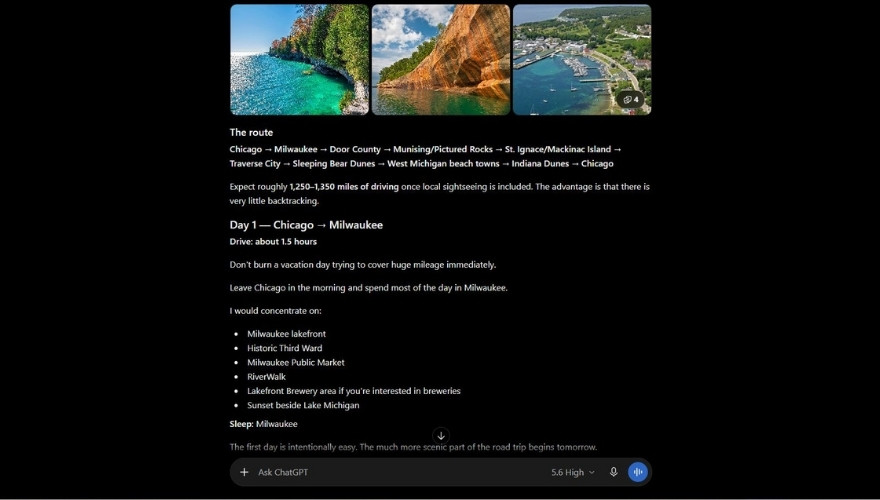
Fewer destinations can allow deeper exploration of individual places during travel.
ChatGPT immediately turned the trip into a 12-day loop covering roughly 1,250 to 1,350 miles once local driving was included. More importantly, it explained its reasoning.
The first day, Chicago to Milwaukee, was intentionally easy. Door County received two days instead of being squeezed into an afternoon. Munising got one arrival day and one dedicated Pictured Rocks day.
Mackinac Island included an overnight stay. Traverse City, Sleeping Bear Dunes, and the western Michigan beach towns were divided into separate stages.
An AI can easily create a schedule in which every individual drive is technically possible while the complete vacation feels like an endurance test involving parking lots. ChatGPT largely avoided that.
It Was Willing to Leave Things Out
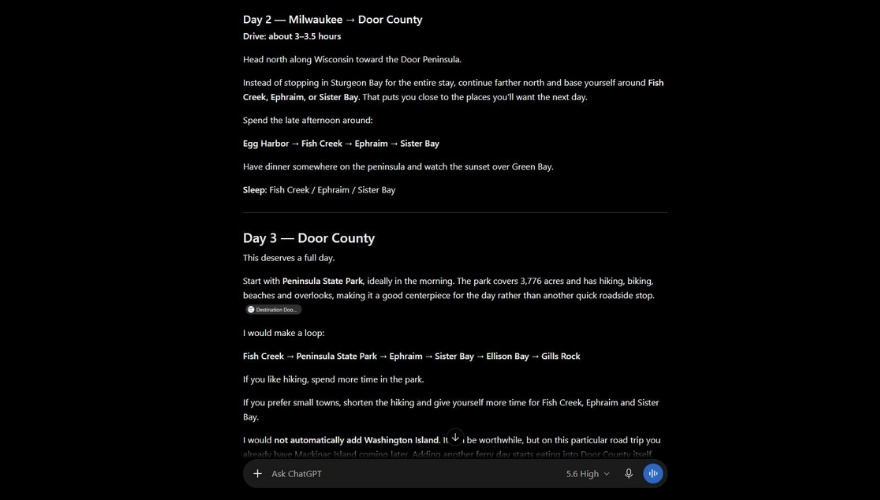
One of its better decisions came in Door County. Rather than automatically adding Washington Island because it is another recognizable attraction, ChatGPT argued against it.
Mackinac Island already created another ferry-based island day later in the trip, so adding Washington Island could reduce the time available for Door County itself.
That is useful itinerary planning rather than destination collection. The same thing happened at Sleeping Bear Dunes. Instead of producing a list of every available hike, it suggested choosing one.
The model repeatedly treated time as a limited resource, which is exactly what a road-trip planner needs to do.
The Pacing Was Particularly Strong
The western Michigan section is where the real difference is. ChatGPT did not try to cover every lakefront town in one day.
Sleeping Bear led into Holland and Saugatuck, followed by a separate slower day through South Haven and St. Joseph. That costs an extra day. It also means somebody might actually remember visiting these places.
The model even identified which parts it would cut if the trip needed to become shorter. Milwaukee could be reduced. Traverse City and Leelanau Peninsula could be combined.
The western beach-town section could lose stops. Door County, Pictured Rocks, the Mackinac overnight, and Sleeping Bear were treated as the sections worth protecting.
It Also Explained Why Certain Choices Made Sense
There were several small examples of this. Staying farther north in Door County reduced unnecessary driving the following morning.
Taking the Pictured Rocks cruise made sense because the cliffs are best appreciated facing the water. Sleeping on Mackinac Island allowed travelers to experience it after many day visitors had left. ChatGPT included practical figures such as:
- Park sizes
- Trail mileage
- Seasonal cruise information
- Approximate driving times
- Crowd considerations
Several factual claims were visibly connected to named sources such as the National Park Service and Michigan tourism resources in the answer I received.
I must say that the main weakness was its length. ChatGPT had an explanation for almost everything.
That is useful when planning, but somebody looking for a quick itinerary might find themselves reading a small travel memo. I would rather shorten a detailed good plan than repair a short bad one, though.
Claude Made the Trip More Adventurous
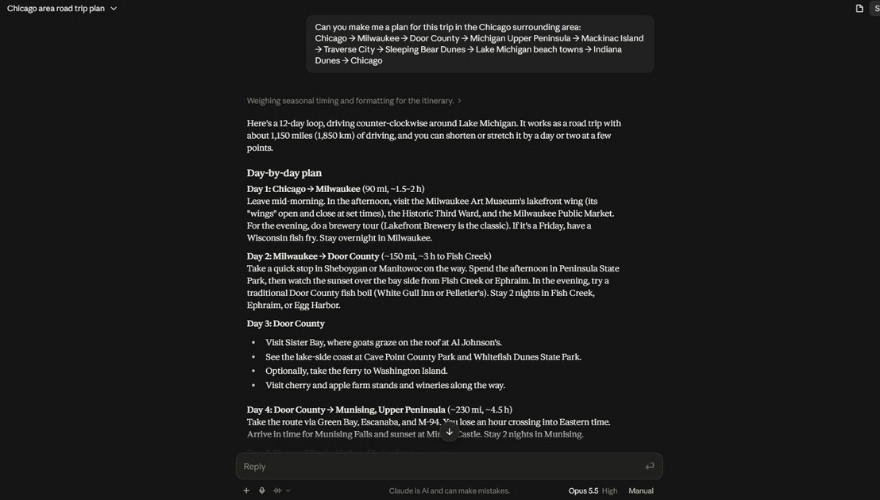
Claude also produced a 12-day itinerary, estimating about 1,150 miles of driving.
Its basic structure was similar to ChatGPT’s, but Claude was more aggressive about adding interesting detours.
That made its answer both exciting and slightly more dangerous to follow without editing.
Claude Found Stops the Other Plans Missed
On the way through northern Michigan, it added Tahquamenon Falls. After Mackinac Island, it suggested the Tunnel of Trees, Harbor Springs, Petoskey, and Charlevoix before reaching Traverse City.
Those are exactly the types of additions that can turn a route between two major stops into part of the trip itself. Claude also supplied several highly specific local ideas:
Its itinerary had personality. If ChatGPT behaved like the friend with the spreadsheet, Claude behaved like the friend who keeps saying, “Since we’re already nearby…” Sometimes that friend improves the vacation considerably. Sometimes dinner happens at 9:47 p.m.
Some Days Started Getting Crowded
The plan sends the traveler off Mackinac Island, through Mackinaw City, along the Tunnel of Trees, into Harbor Springs, Petoskey, Charlevoix, and eventually Traverse City.
It is also several activities disguised as a three-hour driving day. The listed driving estimate may describe wheel-turning time reasonably enough, but it does not describe the day a traveler will experience once ferry logistics, stops, walking, parking, meals, and sightseeing are included. Day 11 has a similar problem. Claude proposed Point Betsie, Frankfort, Ludington, Pentwater, Grand Haven, Holland, and then an overnight in Saugatuck. That is a lot of Lake Michigan before bedtime. Every extra stop reduces what can be done at the previous one.
Claude Had the Best Practical Detail Nobody Else Mentioned
Wisconsin and Chicago operate on Central Time, while much of Michigan on this route operates on Eastern Time. A traveler moving into the Upper Peninsula can suddenly lose an hour without having driven any farther. That is exactly the kind of logistical detail that can quietly ruin a reservation.
Claude also clearly explained how to shrink the itinerary and where an extra day would be most useful. Its plan remained adjustable even though some individual days needed editing.
Overall, Claude created a very good road trip. I would go through it with a red pen and remove a few attractions before booking anything.
Gemini Gave Me Destinations Before It Gave Me an Itinerary
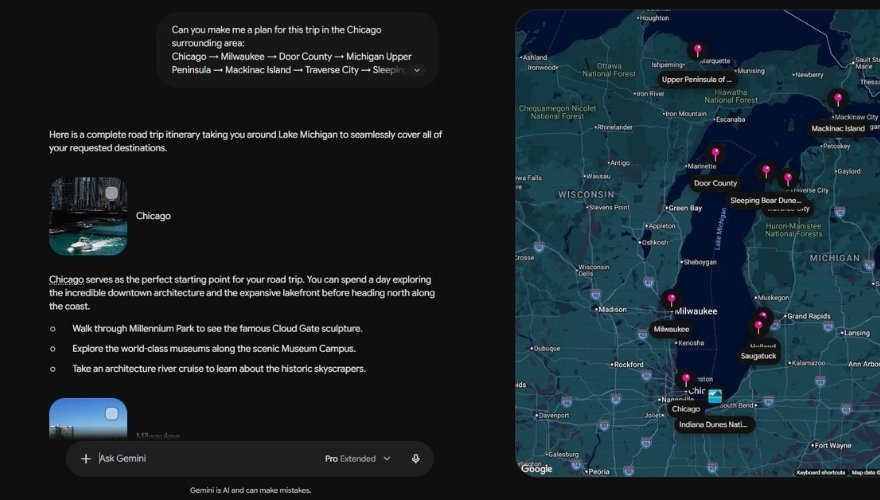
Gemini approached the task differently, because its first answer was essentially a destination-by-destination overview. Chicago had Millennium Park, museums, and the architecture cruise.
Milwaukee had the Art Museum, breweries, and Third Ward. Door County had Peninsula State Park, cherry pie, and fish boils. The pattern continued around the lake.
As destination research, it was useful, but as an itinerary, it was simply not complete. There were almost no day assignments, little route pacing, limited driving information, and no serious attempt to explain how long each location deserved.
Gemini then asked how many days I wanted to dedicate to the loop. The problem is that the other two models had already taken the available information and proposed a workable duration themselves.
Gemini Improved After a Follow-Up
I then asked how many days the trip should take. Gemini recommended 12 to 14 days and produced a 14-day outline, and that was much closer to what I originally needed.
Door County received two days. Mackinac received two. Traverse City and Sleeping Bear occupied three days. Holland and Saugatuck got two. Indiana Dunes became the final major stop before Chicago.
The pacing was relaxed, and, in fact, sometimes too relaxed. Two full days on Mackinac Island could make sense for somebody specifically interested in the island, but neither ChatGPT nor Claude thought it required that allocation within this particular loop.
Meanwhile, the Upper Peninsula received essentially one travel day. That feels like an odd distribution for a route specifically containing Michigan’s Upper Peninsula.
Gemini mentioned forests, US Highway 2, and Fayette Historic State Park in its first response, but it never developed the UP into a major itinerary section comparable to Pictured Rocks in the other two plans.
The Answer Looked More Like a Maps Product
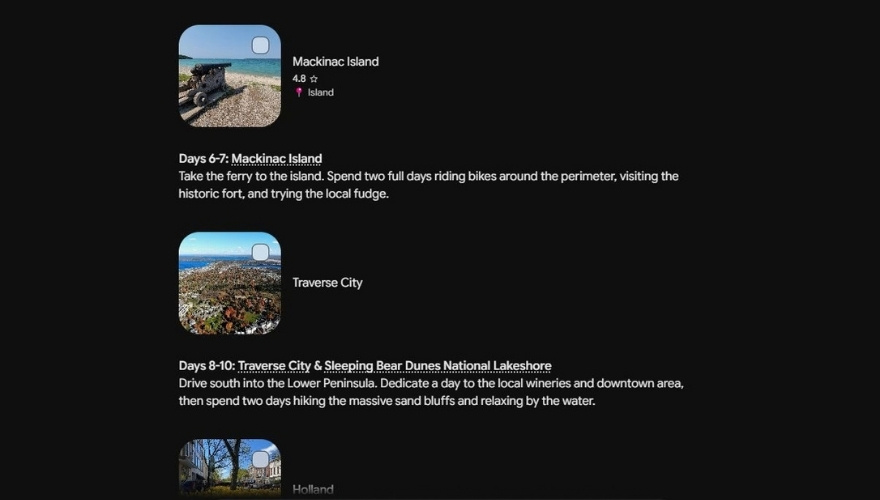
Gemini’s response also contained place ratings, open-status information, and “click to open side panel” elements. Those can be handy inside the product interface.
They did not improve the written itinerary much. A 4.9-star rating beside Sleeping Bear Dunes tells me considerably less than knowing when I should arrive, what part of the park to prioritize, and how much time to allow.
Gemini therefore gave me plenty of information but fewer decisions. That distinction became important across the entire test.
Claude Was Better at Asking “What Else Is Nearby?”
This is where I would choose Claude for certain travelers. If I already had the basic route and wanted AI to find interesting additions, Claude’s answer was excellent.
Tahquamenon Falls and the Tunnel of Trees are exactly the sort of ideas I want an AI travel assistant to surface. I can always remove them afterward.
Its destination suggestions also tended to be concrete. It did not merely recommend “seeing the coast.” It suggested Point Betsie Lighthouse. It did not just say “explore Door County.”
The result mentioned Cave Point, Whitefish Dunes, a fish boil, and even Al Johnson’s roof goats. Claude was particularly good at making the trip sound like somewhere I wanted to go.
ChatGPT Was Better at Asking “Should We Actually Do That?”

That was the more valuable skill in this test. ChatGPT seemed more willing to reject an attraction, protect a full day, or deliberately create a slower section. Its Washington Island decision is probably the clearest example.
The attraction is good. However, the question is whether Washington Island improves this particular 12-day trip enough to justify the ferry time when Mackinac Island is already coming later.
ChatGPT asked it more consistently, and it did the same thing with hikes, beach towns, and arrival days. The result was an itinerary that felt less like a database had successfully emptied itself onto my vacation.
Where Gemini Still Makes Sense
Gemini’s weaker performance here does not mean it was useless. Its destination summaries were concise and easy to scan. The integrated place information could also be useful when somebody is still deciding which locations interest them. If I were at the beginning of the process and wanted to browse possibilities, that presentation has advantages.
But once the task becomes “turn these locations into a trip,” I need the AI to start making decisions. How long should I stay? Which stop can be skipped? Is this drive reasonable after a morning hike?
Should I sleep here or continue another 90 miles? Gemini answered fewer of those questions without being pushed. That meant I had to become the travel planner again, which slightly defeats the purpose of asking an AI to be the travel planner.
So Which AI Planned the Best Trip?
For this test, ChatGPT produced the best overall itinerary. The 12-day structure was coherent. Major destinations received enough time. Long drives were acknowledged instead of quietly hidden between attractions.
Optional activities were treated as optional. It explained what to cut, what to protect, and why certain stops deserved more time.
Claude finished very close behind. I liked some parts of its route more, especially Tahquamenon Falls and the northern Lower Peninsula detours. If I were customizing the final trip for myself, I would probably steal several Claude ideas and insert them into ChatGPT’s structure. Gemini finished third because the initial answer did not really solve the scheduling problem.
The 14-day version improved considerably after a follow-up, but the Upper Peninsula still felt underdeveloped and the allocation of days was less convincing.
I tested one route, with one set of outputs, using three particular reasoning modes. Change the destination, prompt, travel style, budget, or model version, and the result could change too.
That is why I would not turn this into “ChatGPT is better at travel.” The narrower conclusion is more useful. For this Lake Michigan road trip, ChatGPT behaved most like a planner.
Claude behaved most like an enthusiastic road-trip expert. Gemini behaved most like a very well-informed destination browser.
And if I were actually booking the trip tomorrow, I would use ChatGPT’s itinerary as the base, steal a few of Claude’s stops, and still check every ferry schedule before giving anybody my credit-card number.