

Michelin trusts humans to judge some of the world’s best restaurants. An AI detector apparently isn’t so sure humans wrote about them.
An October 2026 investigation into Michelin’s Dallas restaurant descriptions produced a rather uncomfortable result. AI detection tool Pangram flagged 25 of 31 sentences, approximately 80.6%, across six restaurant descriptions as AI-generated.
Michelin insists its inspectors wrote the descriptions themselves, without AI assistance during writing or editing.
Unfortunately for Michelin, researchers at Carnegie Mellon University identified additional linguistic patterns associated with AI-generated writing, particularly GPT-4o.
Does that mean somebody secretly asked ChatGPT to write about Dallas restaurants? Possibly. But detecting AI-like writing and proving AI authorship are two different technical problems.
And confusing those problems is how a suspicious result becomes an accusation.
In this article
What Triggered the Investigation?
Trouble started before Michelin officially updated its Texas restaurant guide on October 8, 2026.
A Dallas chef noticed suspicious wording in Michelin’s revised description of Sushi Kozy and contacted restaurant critic Brian Reinhart.
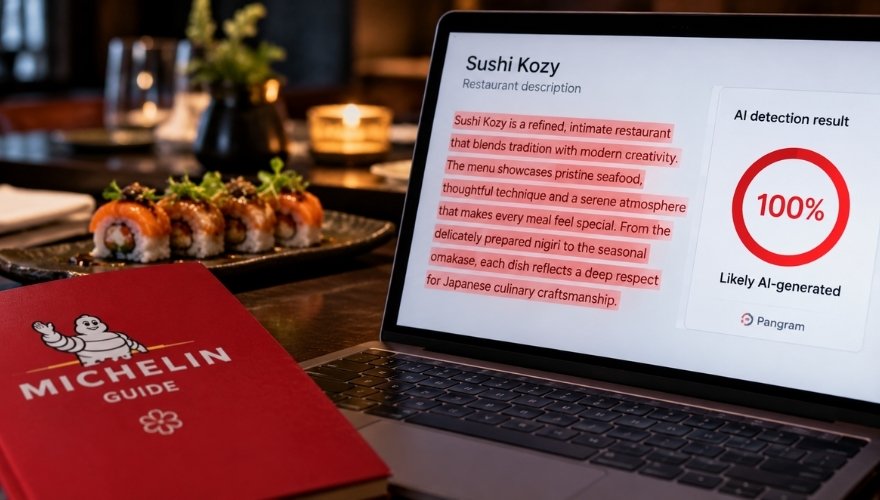
Reinhart submitted the description to Pangram, an AI detection platform that analyzes writing for patterns associated with large language models.
Pangram classified the entire Sushi Kozy description as AI-generated.
One suspicious result isn’t particularly convincing, so Reinhart expanded the investigation.
The investigation gained wider attention after a video highlighted the allegations that Michelin used AI to write descriptions of Dallas restaurants.
- Fond
- Jashan
- Mābo
- Olōyō
- Resident Taqueria
Combined with Sushi Kozy, approximately 650 words across six descriptions produced a striking result.
Reported October 2026 test results. Sentence counts, not independently verified authorship. Earlier Michelin descriptions covering Dallas in 2024 and 2025, alongside 2026 descriptions covering several other cities, did not produce comparable detection results.
Something about the new Dallas writing appeared different.
Importantly, AI detectors are statistical classifiers. They learn characteristics associated with human and machine-generated text, then estimate which category a new passage resembles.
They cannot inspect an author’s writing history or retrieve the original prompt that supposedly generated a paragraph.
A suspicious classification is evidence worth investigating, not a verified account of how the writing happened.
The Writing Had More Than a Few AI-Like Habits
Pangram wasn’t the only reason Michelin’s descriptions attracted attention.
Carnegie Mellon researchers Alex Reinhart and David Brown examined the language and identified patterns associated with GPT-4o.
Their 2025 research published in Proceedings of the National Academy of Sciences examined how large language models differ linguistically compared with human writers.
Results showed that GPT-4o used nominalizations approximately 2.1 times as frequently as humans in the study’s datasets.
A nominalization occurs when a verb or adjective becomes a noun. Think prepare becoming preparation or develop becoming development.
Perfectly legitimate English. Nothing suspicious about one appearing in a restaurant description.
But frequency matters.
Researchers identified 19 nominalizations in roughly 650 words of Michelin’s Dallas text, including four uses of “preparations.”
Repeated adjectives offered another clue.
Words such as “thoughtful,” “careful,” and “serene” appeared frequently, matching vocabulary preferences associated with GPT-4o.
Researchers also noticed predictable lists and adjective-heavy phrasing.
One description of Resident Taqueria connected thoughtful food combinations, bold flavors, and generous portions with the kitchen’s creativity.
Generous portions are wonderful. Their relationship with creativity is slightly harder to establish.
Apparently, the sentence wasn’t particularly interested in explaining it. Why grammatical patterns matter more than suspicious words Individual words are weak evidence because humans use them too.
Grammatical patterns provide more information about how a writer constructs sentences.
In their 2025 study, Carnegie Mellon researchers found GPT-4o used present participial clauses approximately 5.3 times as frequently as human writers and phrasal coordination approximately 1.9 times as frequently.
Together, these tendencies can create recognizable writing patterns.
Comparing Dallas descriptions with approximately 600 words of Michelin’s San Antonio descriptions revealed a considerably lower nominalization rate in the San Antonio sample.
Still, identifying a writing style resembling GPT-4o doesn’t establish that GPT-4o produced the finished text.
Models can share linguistic characteristics. Human editors can also adopt formulaic styles.
Michelin Denies It. How Reliable Is the Detector?
Michelin maintains that its restaurant descriptions are developed collaboratively by inspectors using observations collected during actual restaurant visits. Company representatives explicitly denied using AI during either writing or editing.
So how much confidence should readers place in Pangram?
According to Pangram’s testing methodology, its overall false-positive rate is approximately one in 10,000, although performance varies across different writing categories.
A false positive occurs when genuinely human-written text gets classified as AI-generated.
A false negative occurs when AI-generated writing escapes detection.
False positives can get surprisingly ridiculous. In one reported experiment, ZeroGPT classified the U.S. Constitution as 98.72% AI-generated, suggesting that the Founding Fathers used ChatGPT roughly 235 years before the technology existed.
Different detector, different test, but an excellent reminder that a confident percentage isn’t the same thing as proof.
Independent research provides useful context.
A 2026 study published in the International Journal for Educational Integrity evaluated AI detection tools using 160 documents with known authorship.
Pangram performed better than competing tools, including when evaluating AI-assisted and human-edited writing. Researchers nevertheless cautioned against treating detection results as conclusive evidence in consequential decisions.
An important distinction applies to Michelin’s results.
An 80.6% flagged-sentence rate does not mean an 80.6% probability that Michelin used AI.
It means 25 sentences received AI classifications. Converting that proportion into a probability of authorship would require additional evidence and statistical assumptions.
Another complication is document length. Pangram acknowledges that shorter passages generally provide less information for reliable classification.
Michelin’s six descriptions totaled approximately 650 words, but individual descriptions were considerably shorter.
Without original drafts, revision histories, or other direct evidence, identifying an actual author or editing process remains unresolved.
Why This Matters Beyond Michelin
Michelin’s reputation depends heavily on human judgment.
Inspectors visit restaurants, assess cooking, and help determine which establishments deserve international recognition.
Consequently, the authenticity of Michelin’s descriptions matters even if AI involvement wouldn’t automatically invalidate an inspection.
Fond chef Brandon Moore reportedly suspected AI involvement after receiving a preliminary version of his restaurant’s description.
His reaction introduces an important distinction.
A genuine restaurant inspection followed by AI-assisted editing is fundamentally different from an AI system inventing restaurant observations.
No verified evidence establishes that Michelin skipped inspections or fabricated dining experiences.
But generic descriptions can still create problems.
Imagine two restaurants offering completely different experiences. One specializes in complex Japanese preparations, while another specializes in inventive Mexican street food.
If both descriptions primarily praise careful technique, thoughtful ingredients, and impressive creativity, readers learn surprisingly little about either restaurant.
For additional perspective, Carnegie Mellon’s 2025 research reported that its multiclass classifier incorrectly labeled 9.8% of human texts as AI-generated under the study’s test conditions.
That figure isn’t Pangram’s error rate. It demonstrates why accuracy statistics must always be interpreted according to the particular model, dataset, and evaluation method.
A student wrongly accused of submitting AI-generated coursework could face disciplinary consequences. A hiring manager might reject a legitimate writing sample after trusting an automated classification.
Strong detection performance is valuable, but treating any classifier as an infallible judge creates another problem entirely.
A Suspicious Result Isn’t a Verdict
Michelin’s Dallas controversy produced a compelling collection of clues.
Pangram flagged most sentences, academic researchers identified unusual linguistic characteristics, and earlier Michelin descriptions appeared stylistically different.
Taken together, those observations justify serious questions about the writing process.
They do not conclusively establish AI authorship, and Michelin continues to deny using AI.
Perhaps the most useful lesson concerns how people interpret detection software.
An AI detector can identify writing worth examining. It cannot replace documented evidence, editorial accountability, or careful human judgment.
Michelin doesn’t need an algorithm to describe a good restaurant. It needs writing that explains why the food deserves attention.
Who actually produced those Dallas descriptions is still an open question.