


Holiday shopping has a remarkable ability to turn an ordinary browser into a disaster area. Five gift ideas become 15 shopping tabs, three retailer accounts, and a suspiciously cheap pair of headphones that turns out to be last year’s model.
Google thinks it has a solution.
On October 15, 2026, Google launched Universal Cart in the United States, promising to collect products across retailers, monitor price reductions, and notify shoppers when better deals appear. Instead of checking five websites every morning, you can supposedly leave the detective work to Google.
I wanted to examine that promise using five typical holiday purchases: wireless headphones, a coffee maker, running shoes, a skincare gift set, and a LEGO set.
One important limitation: No completed 10-to-14-day test log or verified alerts are available for these five gifts.
Rather than manufacture a suspiciously successful shopping experiment, I’ll separate Google’s documented capabilities, the checks needed for each gift, and the findings that still require verification.
In this article
What Google’s Universal Cart Actually Does
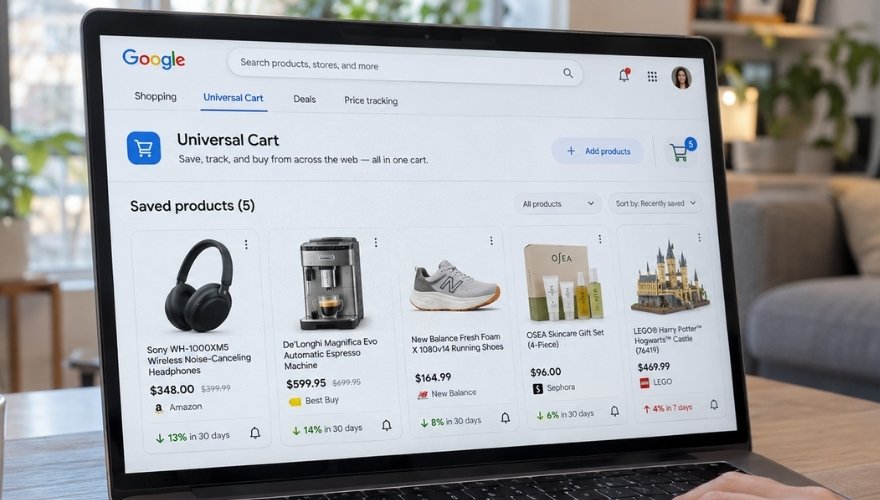
Universal Cart works across Google Search, including AI Mode, and the Gemini app.
Shoppers can save products offered by different retailers without maintaining separate wish lists.
Google’s October 2026 Universal Cart announcement describes several capabilities:
- Price-drop notifications for saved products.
- Restock alerts when unavailable items return.
- Promotional code suggestions and potential credit card benefits.
- Checkout through Google Pay with participating retailers or transfers to merchant websites.
Behind those features sits Google’s Shopping Graph, which contained more than 60 billion continually refreshed product listings as of October 2026.
Google’s shopping operation isn’t exactly small. Back in May 2026, the company reported more than a billion shopping activities across its services every day.
Universal Cart therefore operates alongside an enormous amount of product information and shopping activity. Impressive infrastructure, certainly.
But a billion shopping interactions don’t tell us how reliably the system catches a $15 price reduction on the exact headphones somebody wants.
Sixty billion sounds impressive. Unfortunately, having an enormous product database doesn’t automatically guarantee that every price is current.
Retailers supply product information through shopping feeds, and listings can change as merchants update prices, inventory, and promotional offers.
Google may detect a reduction in a product listing before a shopper visits the retailer. But an advertised price isn’t necessarily the final checkout price.
Shipping fees, coupon restrictions, and product variations can introduce differences. Universal Cart also doesn’t automatically buy every discounted item. Shoppers control purchases, including checkout actions supported through participating merchants.
How I Would Test Five Holiday Gifts
A useful test needs more than collecting notifications and declaring Google brilliant whenever a price turns green.
For each gift, I would record the exact product name, model number or stock-keeping unit (SKU), retailer, starting price, and relevant variations.
Monitoring would run for 10 to 14 days, with independent checks of retailer listings and checkout totals.
| Holiday gift | What needs verification |
| Wireless headphones | Correct model and price-drop notification |
| Coffee maker | Advertised price versus checkout total |
| Running shoes | Exact size, color, and discounted availability |
| Skincare gift set | Valid coupons and eligible products |
| LEGO set | Accurate discounts and stock status |
NRF’s October 2026 survey found that 64% of consumers were likely to wait until Thanksgiving weekend to complete most of their purchases, even though 43% planned to start browsing and buying before November.
A two-week test in October can examine Google’s notification behavior, but it won’t necessarily capture the promotions shoppers encounter during the busiest late-November sales period.
A successful notification would identify the correct product at a genuinely reduced price that a shopper could actually obtain.
Discounts requiring unavailable coupon codes wouldn’t count. Neither would offers for different products or unavailable inventory.
Crucially, Google would also need to receive credit for catching a reduction before it disappeared. Otherwise, a perfectly valid notification could look like an error simply because a retailer ended its sale.
That distinction matters when judging any automated price tracker.
Five Gifts, Five Ways Google’s Shopping Cart Could Get It Wrong
Each of the five gifts presents a different challenge for Google’s Universal Cart.
Headphones can have confusing model numbers, coffee makers come with unexpected shipping costs, and running shoes can appear discounted in every size except the one you need.
Coupon restrictions and stock availability add two more complications.
Here’s what could go wrong with each purchase and how to tell a genuinely useful price alert apart from a deal that looks better on Google than it does at checkout.
Wireless Headphones
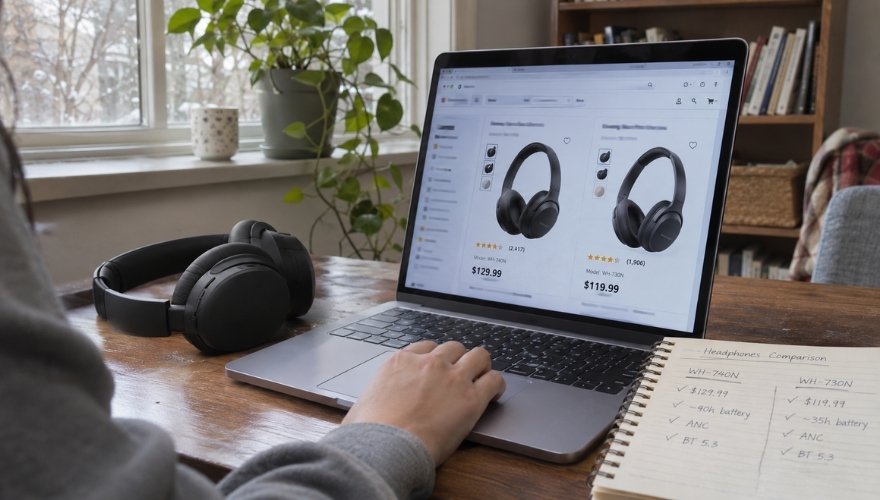
Headphones offer a straightforward opening test, at least until model names get involved.
Manufacturers frequently sell several generations with nearly identical branding. A discounted older version can look remarkably similar to a newer model in search results.
Adobe Analytics found that online electronics promotions peaked at 30.9% off listed prices during the 2025 holiday season.
Unfortunately, a big discount doesn’t automatically mean Google has identified the right headphones.
A 30% reduction on an older model is still a discount on an older model, regardless of how enthusiastically the shopping interface presents it.
A proper comparison therefore needs an exact model number.
Consider an illustrative situation involving headphones initially priced at $199.99. A retailer reduces the correct model to $169.99, while another seller advertises an older version for $149.99.
Google should identify the $30 reduction on the correct headphones, not mistake the older product for a better offer.
Success would also require checking the seller and any additional costs.
No verified headphone price reduction or Universal Cart notification has been documented for the proposed test.
Consequently, its detection performance cannot yet be scored.
Coffee Maker
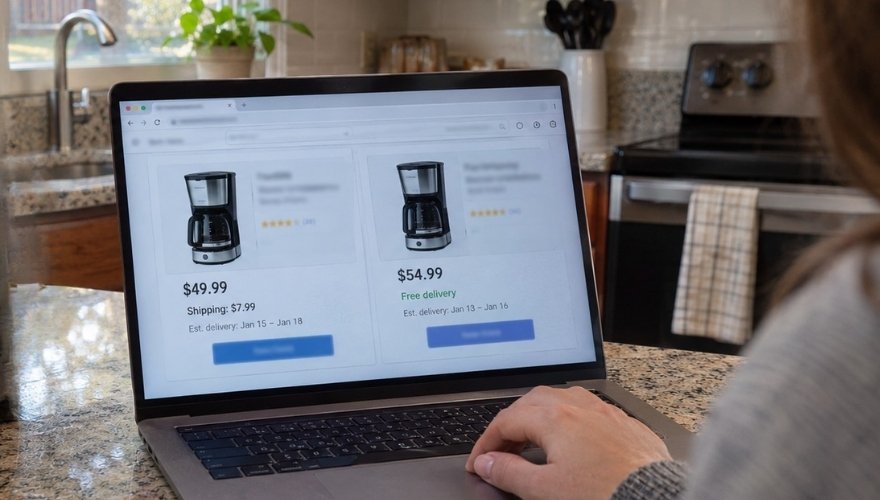
Coffee makers introduce a problem that comparison tools don’t always communicate clearly.
Imagine two retailers advertising an identical machine.
One offers it for $79.99 with $12.99 shipping. Another charges $84.99 with free shipping.
Store B costs $7.99 less despite showing a higher product price.
A notification identifying Store A as the cheapest listing wouldn’t necessarily be incorrect about the item’s advertised price. It would, however, provide an incomplete comparison of the buyer’s actual expense.
Membership requirements, delivery locations, and checkout-only promotions introduce additional complications.
For coffee makers, I would judge Google’s usefulness using the total payable amount, not the biggest advertised percentage discount.
Running Shoes
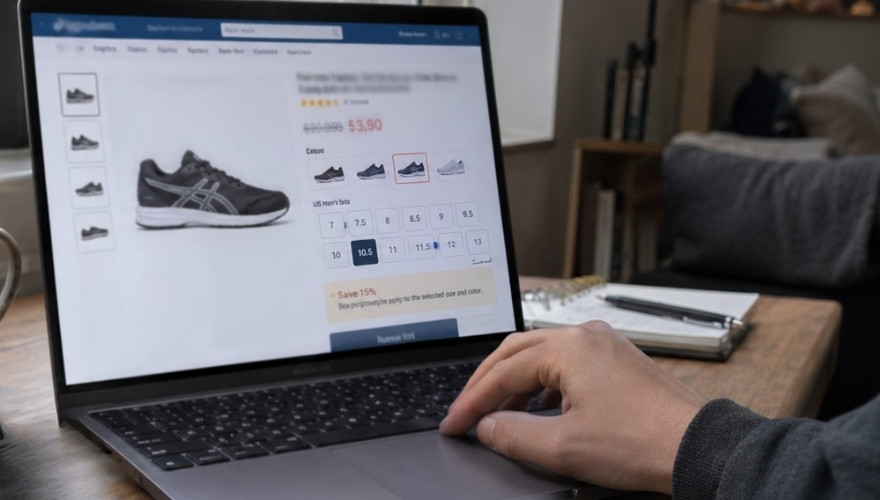
Running shoes are particularly good at exposing product-matching problems.
A retailer might advertise a model at 40% off, but that discount could apply exclusively to a single size or unpopular color.
Someone shopping for men’s size 10 in black doesn’t benefit much when the only discounted pair is women’s size 6 in neon orange.
Retail product catalogs often distinguish these variations through individual SKUs or variant identifiers.
Accurate matching requires the system to associate pricing and inventory with the selected variation, rather than the general product family.
For a meaningful test, I would save one exact combination and check every suggested deal against it.
A discounted shoe in the wrong size would count as an irrelevant offer, not a successful price-drop detection.
Skincare Gift Set

Skincare gift sets create another opportunity for shopping software to become confidently unhelpful.
A retailer might advertise 20% off selected beauty products, while excluding bundles, certain brands, or holiday sets.
Google could correctly discover the promotion without establishing that it applies to the saved item.
Consider a $60 gift set with a suggested 20% coupon.
Potential savings would equal $12, bringing the product to $48 before taxes and any delivery charges.
But suppose checkout rejects the code because gift sets are excluded.
Actual coupon savings would be $0.
That isn’t a minor technical distinction. It’s the difference between identifying a promotion and identifying an obtainable discount.
A useful Universal Cart notification should lead to a coupon that works for the specific purchase, under the relevant conditions.
LEGO Set
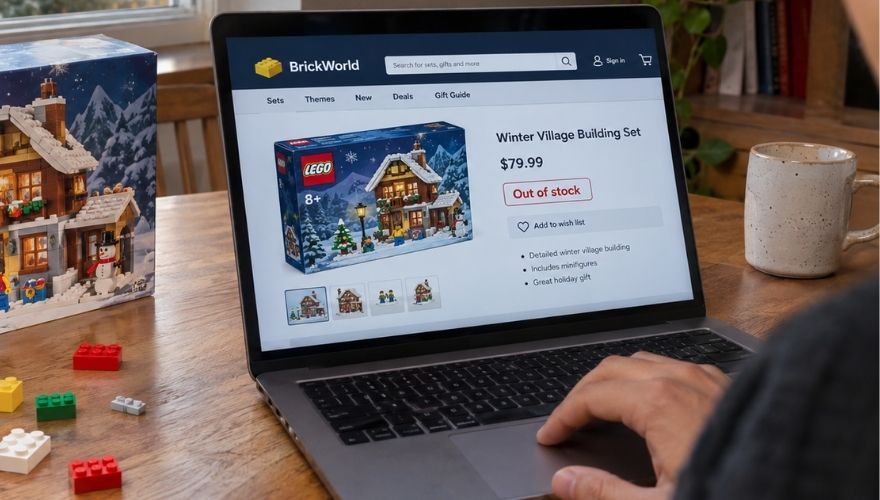
LEGO sets bring inventory into the experiment.
Popular products can experience temporary shortages, especially during holiday promotions.
Google says Universal Cart can notify shoppers when saved products return to stock.
A practical test would check both the notification and the actual product availability at the retailer.
An advertised $20 discount is worthless if checkout reports that the set is unavailable.
Timing also matters. An item could legitimately be available when Google sends an alert and sell out before someone clicks it.
That situation should be recorded separately rather than automatically classified as Google’s mistake.
A stronger finding would involve repeated alerts leading to products that were already unavailable when the notifications arrived.
The Results
As of October 26, 2026, the five-product experiment has no supplied observations that establish which discounts Universal Cart caught.
Inventing a success rate would make for an entertaining conclusion, but a terrible product review.
| Gift | What Google needs to catch | What could invalidate the deal |
| Headphones | Lower price on the exact model | Older model or cheaper competing seller |
| Coffee maker | Lowest total purchase cost | Shipping fees or membership requirements |
| Running shoes | Discount on the selected size and color | Reduced price applies to another variant |
| Skincare set | Valid coupon for the exact gift set | Excluded products or expired codes |
| LEGO set | Discount on an available product | Item sells out before checkout |
Five gifts, five potential failure points. A price reduction alone doesn’t establish that Google found a useful deal.
For example, a $20 discount on headphones could represent genuine savings if the correct model is available at that price. A $20 reduction on a LEGO set that’s out of stock provides no immediate purchasing opportunity.
Google’s actual detection rate and realized savings require verified alerts and retailer checkout prices.
Until those observations are available, the comparison identifies what a successful notification must accomplish rather than claiming results that haven’t been measured.
My recommendation: Use this table instead of the original results table. It adds practical value, supports the five-product comparison, and avoids presenting a hypothetical experiment as completed firsthand testing.
Why Google Can Spot a Discount and Still Get the Price Wrong
Universal Cart’s biggest technical challenge is coordinating product information across multiple systems.
Google’s Shopping Graph collects and updates retailer listings, but those listings aren’t necessarily synchronized with every change happening inside merchant checkout systems.
Google acknowledges the timing problem in its own Merchant Center documentation.
Product-feed prices can disagree with retailer websites when updates happen at different times, and Google says rechecking affected products can take hours or days. For a shopping tool tracking short-lived promotions, that’s a meaningful limitation.
A discount could disappear before the product information catches up, leaving shoppers with a notification that was useful several hours earlier but no longer matches the retailer’s current offer.
Possible differences include outdated prices, incorrect product variations, temporary inventory changes, and promotional restrictions.
Google has also developed the Universal Commerce Protocol (UCP), an open standard connecting AI shopping experiences with participating merchant systems.
Its March 2026 UCP updates introduced additional capabilities, including access to selected real-time catalog information covering product variations, inventory, and pricing.
That matters because more direct access to retailer information can reduce dependence on listings that may not represent current availability.
However, UCP support doesn’t automatically eliminate every pricing problem.
Participation and supported features vary by retailer. Google also confirms that UCP-powered checkout is available through select merchants.
A product transferred into a merchant’s shopping cart can still encounter shipping charges, inventory restrictions, and additional checkout conditions.
One overlooked question is when Google checked the price.
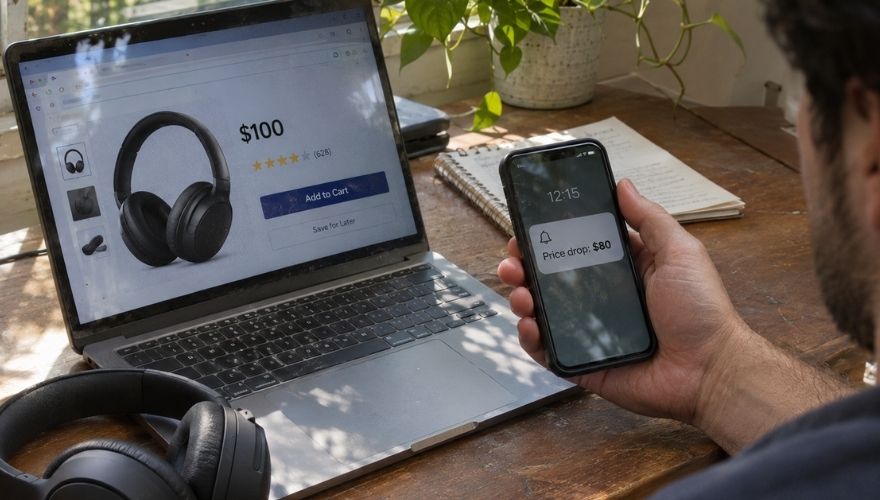
Imagine a product selling for $100 at 9 a.m., dropping to $80 at noon, and returning to $100 by evening.
A notification sent at 12:15 p.m. could be perfectly accurate when generated, yet useless to someone opening it several hours later.
Testing notification quality therefore requires timestamps, not merely screenshots of different prices.
For genuine accuracy measurements, record the notification time, the product details, and the retailer’s accessible offer as close together as possible.
The Verdict
Google’s Universal Cart has a sensible proposition – gather products across retailers, track price changes, and reduce the amount of repetitive shopping research.
Its 60-billion-plus-listing Shopping Graph offers substantial infrastructure for the task, while UCP provides a technical route toward closer merchant integration.
Still, the five-gift experiment hasn’t produced verified findings, so claiming that Google caught a particular number of reductions would be misleading.
My provisional verdict is that Universal Cart looks useful as a shopping organizer and potential discount monitor, but its performance as a dependable deal detector needs independent testing.
Shoppers should pay particular attention to exact product models, clothing sizes, promotional exclusions, stock availability, and checkout totals.
Price notifications can tell you when an offer deserves attention. They aren’t proof that the offer is the cheapest purchasable option.
For someone already shopping through Google Search and Gemini, saving products in one location could eliminate a surprising amount of tab management. But until verified results establish how consistently its alerts correspond to obtainable discounts, I’d treat the tool as an assistant rather than a final authority on prices.
I’ll let Google keep an eye on the gift list. I’ll keep an eye on the checkout total.